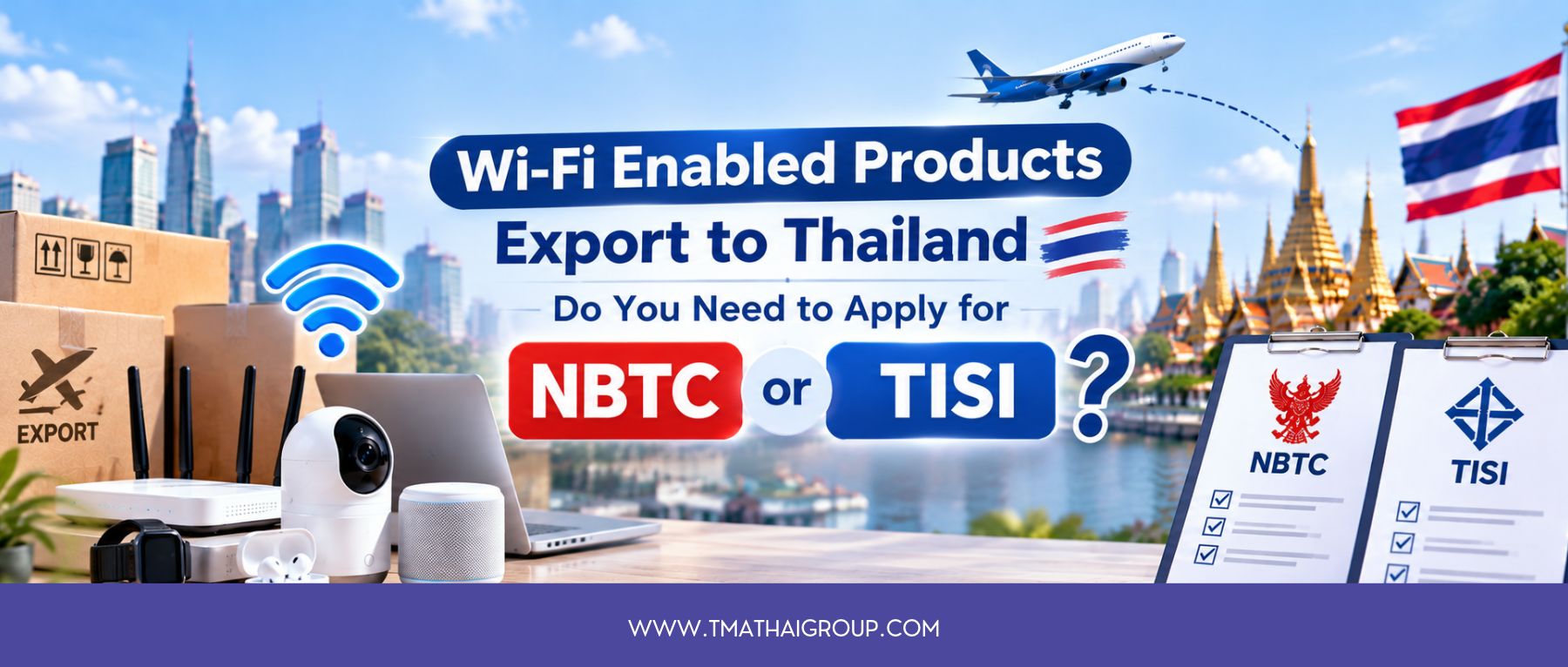
Why Is It Important to Confirm TISI Before Importing Products from China to Thailand?
Emory
Views: 1126
2026-05-25 12:55:53
Comments: 0
About TMA Group
TMA Group is a professional company focusing on local recruitment and corporate consulting in Thailand, dedicated to providing one-stop services including recruitment, financial management, tax disposal, legal consulting, personnel management, etc. for enterprises and individuals. If you need more advice on investment in Thailand, please feel free to contact us.
—— TMA GROUP ——
“Why Is It Important to Confirm TISI Before Importing Products from China to Thailand?”
Nowadays, more and more Thai businesses are choosing to import products from China.
The reasons are straightforward:
China offers a mature supply chain, a wide variety of products, and more competitive costs.
However, before importing, many companies focus only on pricing, logistics, and delivery timelines, while overlooking one critical issue:
👉 Can this product be legally imported and sold in Thailand?
In Thailand, not all products can be directly imported and placed on the market. Certain products must first obtain the relevant Thai standard certification, commonly known as:
👉 มอก. / TISI
Thailand Industrial Standards certification.
TISI stands for the Thai Industrial Standards Institute.
In Thailand, TISI is responsible for establishing and regulating industrial product standards to ensure that products entering the market meet quality and safety requirements.
In simple terms:
👉 Certain products must obtain TISI certification before they can be imported.
👉 Without certification, the products cannot be legally imported or sold.
Common product categories involving TISI include:
• Electrical products
• Electronic devices
• Industrial products related to safety
• Certain construction materials, household products, and consumer goods
Whether certification is required cannot be determined solely by the product name. It must be assessed based on the product category, HS Code, intended use, and applicable Thai standards.
Why Is It Important to Confirm TISI Before Importing?
Why Is It Important to Confirm TISI Before Importing?
It is a legal requirement
If a product falls under Thailand’s mandatory certification scope, TISI approval must be obtained in advance.
Without certification, even if the goods have already arrived in Thailand, they may not be able to clear customs properly. This is not simply a matter of “submitting an additional document,” but a direct compliance issue affecting the import process.
To avoid customs and sales risks
If products requiring TISI certification are imported without prior approval, companies may face:
❌ Goods being detained by customs
❌ Fines and penalties
❌ Inability to legally sell the products in the market
❌ Increased procurement, logistics, and warehousing costs
Many companies initially plan to “import first and sell later,” only to discover during customs clearance or sales that TISI certification is required.
At that stage, both the time and costs involved usually increase significantly.
To enhance customer and channel trust
Products that obtain TISI certification have already passed Thailand’s relevant quality and safety standards.
For the Thai market, this is not only a compliance requirement, but also an important foundation of trust when entering distribution channels and dealing with customers and business partners.
Especially for electrical, electronic, and safety-related products, the absence of certification can easily affect customer confidence and purchasing decisions.
Why Do Many Companies Get Stuck with TISI?
Why Do Many Companies Get Stuck with TISI?
In practice, many Thai companies or importers may already know that TISI certification is required, but still encounter various issues during the actual application process, such as:
• Difficulty contacting the Chinese factory
• Low level of cooperation from the factory
• Incomplete document preparation
• Product standards not matching Thai requirements
• Testing documents not compliant with Thai standards
• High communication costs between the Chinese and Thai sides
• Inefficient communication in English or Chinese
As a result, the application process may become prolonged, with repeated document revisions or even application rejection.
This is why TISI may appear to be “just a certification process,” but in reality, it often involves multiple aspects including Thai standards, factory documentation, product testing, import documentation, and cross-language communication.
Why Is It Important to Work with a Service Provider Familiar with Both China and Thailand?
TISI is not simply about submitting documents. It requires an understanding of both:
• Thai TISI certification regulations
• Thai customs and import requirements
• Chinese factory documentation practices
• Product testing and standards alignment
• Communication approaches between China and Thailand
With support from a professional team familiar with both sides, companies can:
✅ Determine in advance whether TISI certification is required
✅ Coordinate with Chinese factories on document preparation
✅ Reduce document errors and repeated revisions
✅ Improve approval efficiency
✅ Lower the risk of goods being detained or unable to enter the market
For many companies, the real loss is not the certification cost itself, but the situation where products have already been manufactured and shipped before discovering that they cannot clear customs or be legally sold due to lack of prior planning.
For companies planning to import products from China to Thailand, it is recommended to confirm the following before procurement:
Whether the product falls within the scope of TISI regulation
Whether mandatory certification is required
Whether the Chinese factory can cooperate in providing the required documents
Whether the product complies with Thai standards
Whether the certification timeline will affect the import schedule
Do not wait until the goods have already arrived at the port before addressing certification issues.
TISI is not simply a documentation procedure, but an important compliance threshold for Chinese products entering the Thai market. Early confirmation and proper planning can help reduce customs clearance risks, sales risks, and additional costs.
TMA not only supports Chinese companies entering the Thai market, but can also assist Thai local businesses with TISI certification, factory coordination, document preparation, and compliance application processes related to importing products from China.
For businesses that need to source products from China, import them into Thailand, and sell them locally, working with a service provider that understands both the Thai regulatory system and Chinese factory communication practices can make the entire process clearer, more efficient, and more secure.
Disclaimer
TMA Consulting Management has been paying attention to the updating of information through newsletters for many years, but we do not assume any responsibility for the completeness, correctness or quality of the information provided. No information contained in this article can replace the personal consultation provided by a qualified lawyer. Therefore, we do not assume any liability for damages caused by the use or non-use of any information in this article (including any kind of incomplete or incorrect information that may exist), unless it is caused intentionally or by gross negligence.