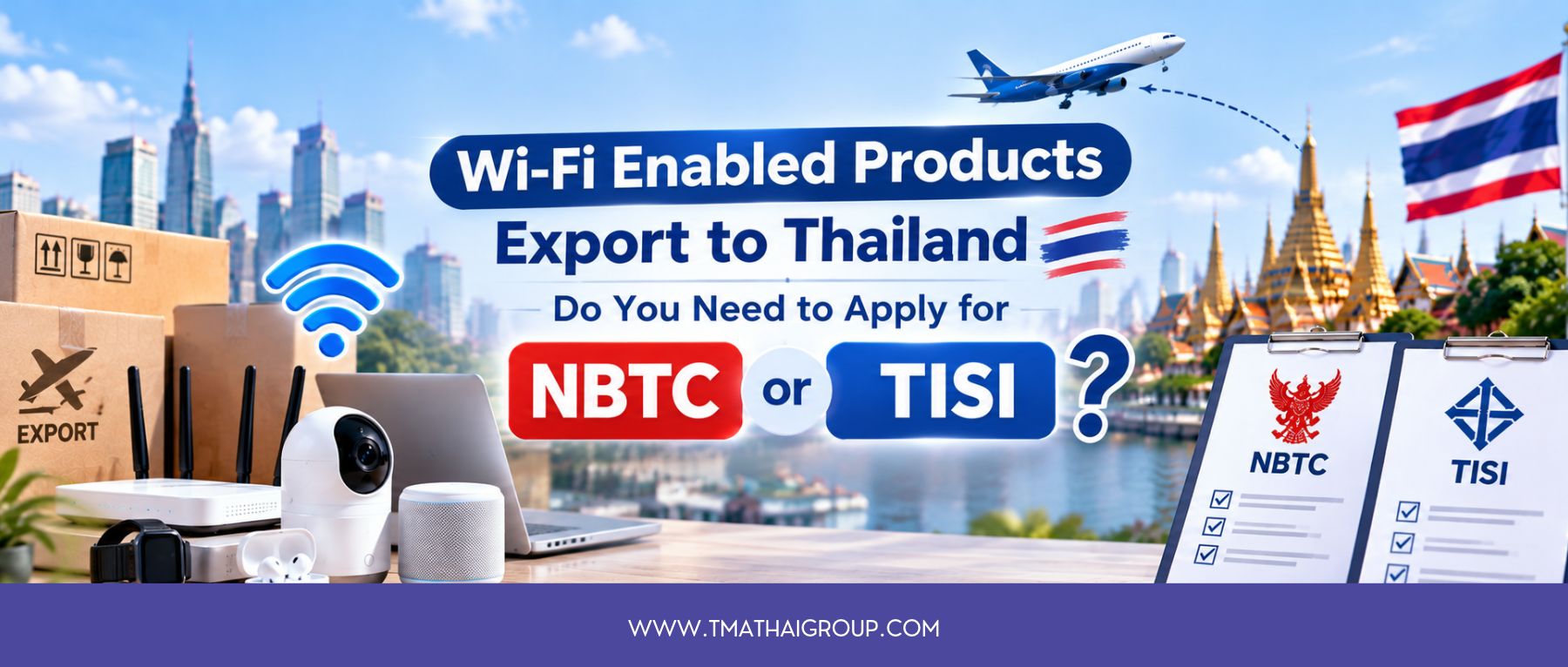
Does a Wi-Fi-Enabled Product Exported to Thailand Require NBTC or TISI Approval?
Emory
Views: 29
2026-09-30 17:33:45
Comments: 0
About TMA Group
TMA Group is a professional company focusing on local recruitment and corporate consulting in Thailand, dedicated to providing one-stop services including recruitment, financial management, tax disposal, legal consulting, personnel management, etc. for enterprises and individuals. If you need more advice on investment in Thailand, please feel free to contact us.
—— TMA GROUP ——
Qualification Application
Products such as smart home appliances, routers, security cameras, and smart plugs often come with built-in Wi-Fi functionality. When exporting these products to Thailand, one common question arises:
Do they require NBTC approval or TISI certification?
The answer is: not necessarily one or the other.
The wireless communication function (such as Wi-Fi) is primarily regulated by the NBTC, while whether the product itself requires TISI certification depends on whether it falls within Thailand's mandatory industrial standards.
Therefore, a product may require NBTC only, or it may require both NBTC and TISI.
Products with Wi-Fi: Start by Checking NBTC Requirements
NBTC
(National Broadcasting and Telecommunications Commission)
The NBTC is responsible for regulating radio communication equipment and telecommunications devices in Thailand.
If a product uses wireless technologies such as Wi-Fi or Bluetooth, its compliance requirements will depend on factors including:
These factors determine the applicable NBTC technical standards and conformity assessment requirements.
Common products subject to NBTC requirements include:
However, having Wi-Fi does not necessarily mean every product follows the same NBTC approval process.
Depending on the product type and applicable technical standards, different conformity assessment procedures may apply, such as Class A, Class B, or Supplier's Declaration of Conformity (SDoC).
Therefore, exporters should first confirm the applicable NBTC requirements based on the product model and wireless specifications before shipping.
Having Wi-Fi Does Not Automatically Mean TISI Certification Is Required
The Thai Industrial Standards Institute (TISI) is responsible for regulating industrial product standards in Thailand.
When determining whether a product requires TISI certification, the key question is not:
"Does the product have Wi-Fi?"
Instead, the correct question is:
"Does this product fall within Thailand's mandatory industrial standards?"
For example, for a smart electrical appliance:
If the product itself is not covered by Thailand's mandatory TISI standards, simply adding Wi-Fi functionality does not automatically make it subject to mandatory TISI certification.
Therefore, NBTC and TISI are governed under different regulatory frameworks and are assessed independently.
When Are Both NBTC and TISI Required?
If a product:
① Includes wireless communication functions regulated by the NBTC;
AND
② Falls within the scope of Thailand's mandatory TISI standards;
then both NBTC and TISI requirements must be satisfied separately.
For example:
A Wi-Fi-enabled electrical appliance
Wi-Fi functionality
→ NBTC compliance
The appliance itself falls under mandatory TISI standards
→ TISI certification
=
Both NBTC and TISI are required.
NBTC approval cannot replace TISI certification, and obtaining TISI certification does not exempt a product from NBTC requirements.
Each authority regulates different aspects of the product.
Before Exporting to Thailand, Perform a Two-Step Assessment
For products equipped with wireless technologies such as Wi-Fi or Bluetooth, it is recommended to assess compliance in the following order:
Step 1: Verify Wireless Functions
Confirm whether the product includes:
Then review the operating frequency and technical specifications to determine the applicable NBTC requirements.
Step 2: Verify the Product Category
Based on the product's name, function, intended use, and technical specifications, determine whether it falls within Thailand's mandatory TISI standards.
Generally, there are three possible outcomes:
| Product Situation | Required Compliance |
|---|
| Product has Wi-Fi but is not subject to mandatory TISI standards | NBTC |
| Product has no wireless function but falls under mandatory TISI standards | TISI |
| Product has Wi-Fi and falls under mandatory TISI standards | NBTC + TISI |
For Wi-Fi-enabled products exported to Thailand, NBTC and TISI are not mutually exclusive.
NBTC primarily regulates wireless communication functions and radio frequency compliance, while TISI determines whether the product itself is subject to Thailand's mandatory industrial standards.
For smart home appliances, consumer electronics, wireless devices, and other products equipped with Wi-Fi or Bluetooth, it is recommended to evaluate NBTC and TISI requirements separately based on the product model, intended use, wireless frequency, and technical specifications before exporting to Thailand. Doing so can help avoid customs clearance delays and compliance issues after the products arrive in Thailand.
TMA GROUP provides professional support for:
Product classification assessment
NBTC compliance evaluation
TISI certification assistance
Import compliance consulting
Product registration and market entry services in Thailand
Disclaimer
TMA Consulting Management has been paying attention to the updating of information through newsletters for many years, but we do not assume any responsibility for the completeness, correctness or quality of the information provided. No information contained in this article can replace the personal consultation provided by a qualified lawyer. Therefore, we do not assume any liability for damages caused by the use or non-use of any information in this article (including any kind of incomplete or incorrect information that may exist), unless it is caused intentionally or by gross negligence.