
Thailand Personal Income Tax Deduction Guide
About TMA Group
TMA Group is a professional company focusing on local recruitment and corporate consulting in Thailand, dedicated to providing one-stop services including recruitment, financial management, tax disposal, legal consulting, personnel management, etc. for enterprises and individuals. If you need more advice on investment in Thailand, please feel free to contact us.
一
站
式
服
务
- Thailand Personal Income Tax Deduction Guide -
If you work in Thailand, your employer will normally withhold Personal Income Tax (PIT) from your salary each month. However, the tax withheld each month does not necessarily equal the final amount of tax you are required to pay for the year.
When filing the annual Personal Income Tax Return, taxpayers may claim various eligible tax deductions based on their individual circumstances, including personal allowances, family-related deductions, insurance premiums, home mortgage interest, retirement savings, and charitable donations.
Making proper use of these tax deductions can legally reduce your taxable income and help avoid paying more tax than necessary.
It is important to note that tax deductions do not mean you receive the deducted amount back in cash. Instead, eligible deductions are first subtracted from your income, and the remaining taxable income is then subject to Thailand's progressive Personal Income Tax rates.
Thailand's Personal Income Tax is not calculated directly based on your total annual salary. Instead, allowable employment expenses and eligible tax deductions must first be deducted before applying the progressive tax rates.
The calculation can be simplified as follows:
Annual Income − Allowable Expense Deduction − Eligible Tax Deductions = Taxable Income
(The applicable Personal Income Tax rate is then applied to the taxable income to determine the final tax payable.)
Example
Assume an employee receives a total annual income of THB 420,000, including salary, bonuses, allowances, and other employment income.
Step 1: Employment Expense Deduction
Employment income is entitled to a standard expense deduction of 50% of income, subject to a maximum deduction of THB 100,000.
For an annual income of THB 420,000:
THB 420,000 × 50% = THB 210,000
However, since the maximum allowable deduction is THB 100,000, the employee may deduct only:
THB 100,000
Remaining income after the expense deduction:
THB 420,000 − THB 100,000 = THB 320,000
Step 2: Personal and Other Tax Deductions
After deducting employment expenses, taxpayers may further claim eligible personal and family-related tax deductions.
Examples include:
Personal allowance: THB 60,000 per taxpayer per year
Social Security contributions: based on the actual amount paid
Eligible life insurance or health insurance premiums
Spouse, children, and parental support allowances (subject to qualifying conditions)
Home mortgage interest (up to THB 100,000 per year, subject to eligibility)
Assume the employee is eligible for the following deductions:
Personal allowance: THB 60,000
Social Security contributions: THB 9,000
Remaining taxable income:
THB 320,000 − THB 60,000 − THB 9,000 = THB 251,000
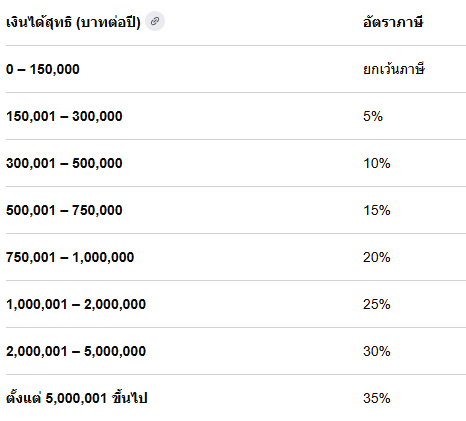
Using a taxable income of THB 251,000 as an example:
The first THB 150,000 is tax-exempt.
The remaining amount:
THB 251,000 − THB 150,000 = THB 101,000This portion is taxed at 5%.
Therefore, the annual Personal Income Tax payable would be approximately:
THB 101,000 × 5% = THB 5,050
In practice, employers generally withhold Personal Income Tax each month based on the employee's estimated annual income.
When the annual tax return is filed, the final tax liability is recalculated using the taxpayer's actual annual income together with all eligible deductions.
If the total tax already withheld exceeds the final tax payable, the taxpayer may apply for a tax refund.
If the tax withheld is less than the final tax payable, the taxpayer will be required to pay the outstanding balance.
1. Personal Allowance
Every taxpayer who legally files personal income tax in Thailand is entitled to a:
THB 60,000 personal allowance.
This is a standard personal allowance and generally does not require proof of actual expenses.
2. Spouse Allowance
If the taxpayer's spouse has no taxable income during the tax year and the couple is legally married, the taxpayer may claim:
THB 60,000
If the couple is only living together without legal marriage registration, the spouse allowance generally cannot be claimed.
3. Child Allowance
Each eligible biological child generally qualifies for a deduction of:
THB 30,000
For the second and subsequent biological children born in or after 2018, an additional:
THB 30,000
may be claimed, subject to the applicable conditions.
Therefore, the maximum deduction for each eligible child is:
THB 60,000
Adopted children are subject to additional eligibility requirements and limitations based on the number of adopted and biological children.
4. Parent Allowance
Taxpayers supporting their own parents, or the parents of a spouse with no taxable income, may claim:
THB 30,000 per parent
The following conditions generally apply:
The parent must be 60 years of age or older.
The parent's annual income must not exceed THB 30,000.
The same parent cannot be claimed by multiple children.
Supporting documents and proof of relationship are required.
5. Allowance for Supporting Disabled or Incapacitated Persons
Taxpayers who care for an eligible disabled or legally incapacitated person may claim:
THB 60,000 per person
The taxpayer is generally required to be the legally registered caregiver and provide disability certificates, medical documents, and any other documents required by the Revenue Department.
6. Pregnancy Check-up and Childbirth Expenses
Medical expenses for prenatal care and childbirth incurred by the taxpayer or a spouse with no taxable income may be deducted based on the actual amount paid.
Maximum deduction per pregnancy: THB 60,000
Hospital receipts and supporting documents should be retained for tax filing purposes.
1. Life Insurance Premiums
Premiums paid for qualifying life insurance policies are deductible based on the actual amount paid, up to a maximum of:
THB 100,000
Please note that not all insurance policies qualify. The policy term, insurance type, and insurance company must meet the requirements set by the Thai Revenue Department.
2. Health Insurance Premiums
Health insurance premiums paid for the taxpayer are deductible based on the actual amount paid, up to:
THB 25,000
However, the combined deduction for life insurance and health insurance premiums is generally capped at:
THB 100,000
Example:
Life insurance premium: THB 90,000
Health insurance premium: THB 25,000
Total premiums paid: THB 115,000
Since the combined deduction limit is THB 100,000, only THB 100,000 may be claimed.
3. Health Insurance for Parents
Health insurance premiums paid for the taxpayer's parents or the parents of a spouse with no taxable income are deductible based on the actual amount paid.
Maximum combined deduction: THB 15,000
The parents must generally satisfy the applicable age, income, and insurance eligibility requirements.
Eligible deductions under this category include:
Thai Social Security contributions
Provident Fund contributions
Retirement Mutual Fund (RMF) contributions
Retirement Life Insurance premiums
Government Pension Fund (GPF) contributions
Other qualified retirement savings plans
Thai Social Security contributions may be deducted separately based on the actual amount contributed during the tax year.
Please note that deductions for Provident Funds, RMFs, Retirement Life Insurance, Government Pension Funds, and other qualified retirement savings plans are subject to a combined maximum deduction of THB 500,000.
The THB 500,000 limit is a shared ceiling for all retirement savings deductions and does not apply separately to each category. In addition, each deduction is subject to its own eligibility requirements, contribution limits, and holding period conditions.
Thai ESG Fund Deduction
Investments in eligible Thai ESG Funds may qualify for a tax deduction based on the actual investment amount, subject to the following conditions:
Up to 30% of assessable income;
Maximum THB 300,000 per tax year;
The investment generally must be held for at least 5 consecutive years from the date of purchase.
Please note that the Thai ESG deduction is calculated separately from the THB 500,000 combined deduction limit applicable to RMFs, Provident Funds, and other retirement savings schemes.
It is also important to understand that Thai ESG funds are investment products and may incur investment losses. They should not be purchased solely for tax-saving purposes.
Charitable Donation Deduction
Donations made to qualified temples, hospitals, foundations, and charitable organizations may be claimed as tax deductions based on the actual amount donated.
Generally, the deductible amount for charitable donations must not exceed 10% of taxable income after other allowable deductions have been applied.
Certain qualified donations for education, healthcare, and public benefit may be eligible for a 200% (double) deduction, subject to the applicable deduction limits.
Donations made through the e-Donation system are generally transmitted directly to the Thai Revenue Department, making the tax filing process more convenient.
Temporary Consumer Tax Incentives
Consumer tax incentive programs, such as Easy E-Receipt, are temporary measures introduced by the Thai government in specific tax years and are not permanent annual deductions.
The eligible period, qualifying purchases, deduction limits, and invoice requirements may vary from year to year.
Therefore, taxpayers should always refer to the official guidelines issued by the Thai Revenue Department for the relevant tax year, rather than relying on the previous year's rules.
Foreigners who earn taxable income in Thailand and legally file Thai personal income tax returns are, in principle, eligible to claim applicable tax deductions, including:
Personal allowance
Social Security contributions
Insurance premiums
Retirement savings
Home mortgage interest
Charitable donations
Eligibility is determined not by nationality, but by whether:
The legal requirements for each deduction are satisfied;
The expense was actually paid by the taxpayer;
Supporting documents recognized by the Thai Revenue Department are available; and
The insurance policy, investment fund, mortgage, or charitable organization meets the applicable legal requirements.
For example, a foreigner who legally purchases a condominium in Thailand and obtains a qualifying home mortgage may claim a deduction for the mortgage interest actually paid, in accordance with Thai tax regulations. As foreigners generally cannot directly own land in Thailand, mortgage interest deductions most commonly apply to condominium loans.
Where deductions involve an overseas spouse, children, or parents, additional documents such as a marriage certificate, birth certificate, proof of family relationship, and certified Thai translations may also be required.
In short, foreigners who are legally subject to Thai personal income tax may also enjoy the same tax deductions, provided they meet the applicable requirements and maintain complete supporting documentation.

Summary
TMA Recommendation:
Foreigners who legally earn income in Thailand and file Thai personal income tax returns are generally entitled to claim eligible personal income tax deductions.
Whether a deduction can be claimed depends primarily on meeting the specific legal requirements, having personally incurred the expense, and being able to provide supporting documents accepted by the Thai Revenue Department—not simply on nationality.
Therefore, before filing a tax return, foreign taxpayers are advised to prepare all relevant supporting documents in advance, including employment income records, Social Security contribution records, insurance certificates, investment fund statements, mortgage interest certificates, and family relationship documents, while ensuring compliance with the latest tax regulations issued by the Thai Revenue Department for the relevant tax year.
END




TMA Consulting Management has been paying attention to the updating of information through newsletters for many years, but we do not assume any responsibility for the completeness, correctness or quality of the information provided. No information contained in this article can replace the personal consultation provided by a qualified lawyer. Therefore, we do not assume any liability for damages caused by the use or non-use of any information in this article (including any kind of incomplete or incorrect information that may exist), unless it is caused intentionally or by gross negligence.
Does a Wi-Fi-Enabled Product Exported to Thailand Require NBTC or TISI Approval?
Thailand Personal Income Tax Deduction Guide
What Are PND.50 and PND.51? A Guide to Thailand's Corporate Income Tax Returns
What Is Thailand FDA (อย.)? Which Products Require Approval?

Thailand Trademark Registration Costs Explained

What Is DLD?
What Is NBTC Certification? Which Products Must Obtain NBTC Approval Before Entering Thailand?
Thailand Machinery Registration