Thailand Officially Delays Employee Welfare Fund (EWF) Contributions to January 1, 2027

Emory Views: 12 2026-11-18 17:30:38 Comments: 0

About TMA Group
TMA Group is a professional company focusing on local recruitment and corporate consulting in Thailand, dedicated to providing one-stop services including recruitment, financial management, tax disposal, legal consulting, personnel management, etc. for enterprises and individuals. If you need more advice on investment in Thailand, please feel free to contact us.

—— TMA GROUP ——

Thailand Employee Welfare Fund (EWF)

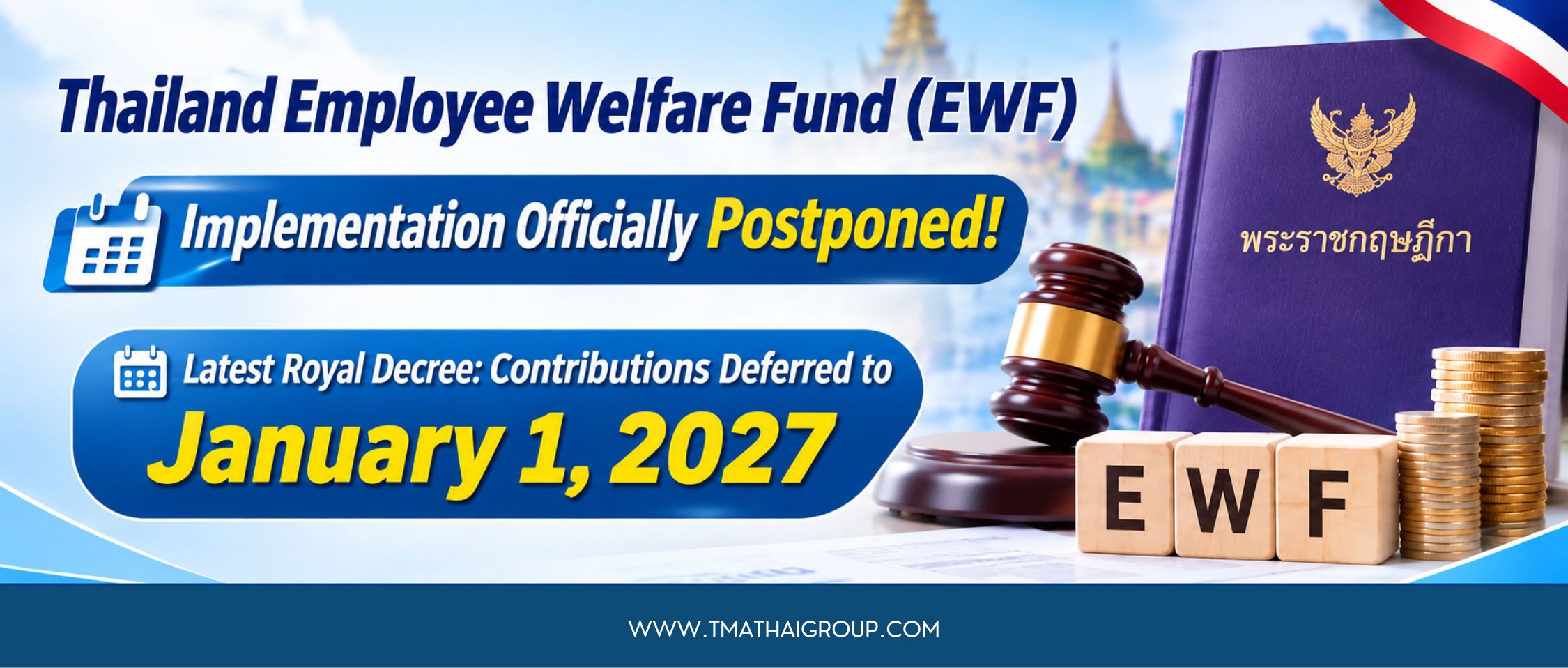
According to the Royal Decree published in the Royal Thai Government Gazette on 22 October 2026, the implementation of Employee Welfare Fund (EWF) contributions, originally scheduled to commence on 1 October 2026, has been officially postponed to 1 January 2027.

This extension provides eligible employers in Thailand with additional time to prepare for compliance, including reviewing employee welfare arrangements, updating payroll systems, and completing the necessary compliance procedures.


01
Key Highlights of the Policy Update


The key official document that employers should pay attention to is:

พระราชกฤษฎีกากำหนดระยะเวลาเริ่มดำเนินการจัดเก็บเงินสะสมและเงินสมทบของกองทุนสงเคราะห์ลูกจ้าง พ.ศ. ๒๕๖๙

Royal Decree Prescribing the Commencement Date for the Collection of Employee and Employer Contributions to the Employee Welfare Fund (EWF), B.E. 2569 (2026)

Under this Royal Decree:

  • The implementation of Employee Welfare Fund (EWF) contributions has been officially deferred to January 1, 2027 (B.E. 2570).

  • Original implementation date: October 1, 2026

  • Revised implementation date: January 1, 2027

  • Applicable employers: In principle, employers with 10 or more employees that do not qualify for statutory exemptions under the relevant law.


02
What Is Thailand's Employee Welfare Fund (EWF)?


The Employee Welfare Fund (กองทุนสงเคราะห์ลูกจ้าง) is a statutory employee protection fund established under Thailand's labor laws.

Its primary purpose is to provide financial assistance to employees in situations such as resignation, death, or when an employer is unable to pay wages, severance pay, or other amounts required under the Labour Protection Act.

According to Thailand's Ministry of Labour, the Fund is intended to protect employees who are affected when employers fail to pay wages, compensation, or other statutory payments required under the Labour Protection Act.

It is important to note that the Employee Welfare Fund (EWF) is not the same as Thailand's Social Security Fund (SSF), nor is it equivalent to a Provident Fund (กองทุนสำรองเลี้ยงชีพ), which is a voluntary retirement savings scheme established by employers.

Instead, the Employee Welfare Fund is a statutory employee protection scheme established under Thailand's Labour Protection Act.


3
Which Employers Are Required to Comply? What Are the Contribution Rates?


Which Employers Are Covered?

Under Section 130 of the Labour Protection Act, employers with 10 or more employees are, in principle, required to enroll their employees in the Employee Welfare Fund (EWF).

However, this requirement generally does not apply if the employer has already established a Provident Fund in accordance with the law, or has provided employee welfare arrangements that meet the requirements prescribed by the relevant Ministerial Regulations for cases such as resignation or death.


What Are the Contribution Rates?

According to the latest official regulations, contributions to the Employee Welfare Fund (EWF) will be implemented in two phases:

Implementation PeriodEmployee ContributionEmployer Contribution
1 Oct 2026 – 30 Sep 2031 (Deferred to 1 Jan 2027 under the latest Royal Decree)0.25% of monthly wages0.25% of monthly wages
From 1 Oct 2031 onwards0.50% of monthly wages0.50% of monthly wages

In other words, during the initial phase, both the employee and the employer contribute 0.25% of the employee's monthly wages. Beginning 1 October 2031, both contribution rates increase to 0.50%.

Example

If an employee earns a monthly salary of THB 30,000:

ItemAmount
Employee contribution (0.25%)THB 75
Employer contribution (0.25%)THB 75
Total monthly contribution to the EWFTHB 150

Note: Under the Royal Decree published in the Royal Thai Government Gazette on 22 October 2026, the commencement date for EWF contributions has been officially deferred to 1 January 2027. Therefore, the contribution rates above will take effect from the revised implementation date.

05
What Happens If an Employer Fails to Contribute or Submit on Time?


For employers that fall within the scope of the law, participation in the Employee Welfare Fund (EWF) is mandatory, not voluntary.

Failure to submit the required information, make contributions on time, or pay the full amount does not exempt an employer from its legal obligations. The competent authority may require the employer to pay the outstanding contributions, together with any applicable surcharges.

According to the relevant regulations, employers who fail to make contributions on time or make incomplete contributions may be required to pay an additional surcharge of 5% per month on the outstanding amount. Labour inspectors may also issue a written notice requiring the employer to settle the outstanding contributions and related charges within the prescribed period.

In addition, employers who fail to submit the required information or provide false information may be subject to imprisonment for up to six months, a fine of up to THB 10,000, or both, in accordance with the law.

If an employer still fails to comply after receiving an official notice, the authorities may take further legal enforcement actions, including compulsory debt recovery and the seizure, attachment, or auction of the employer's assets, as provided by law.

06
Summary


The Employee Welfare Fund (EWF) is a statutory employee protection scheme established under Thailand's Labour Protection Act to provide financial protection for employees in specific circumstances prescribed by law.

Under the latest Royal Decree Prescribing the Commencement Date for the Collection of Employee and Employer Contributions to the Employee Welfare Fund, B.E. 2569 (2026), the implementation of mandatory EWF contributions has been officially deferred to 1 January 2027.

The EWF generally applies to employers with 10 or more employees that have not established a qualified Provident Fund or other statutory employee welfare arrangements as prescribed by law.

Once the scheme takes effect, both employers and employees will initially contribute 0.25% of the employee's monthly wages. Beginning 1 October 2031, the contribution rate for both parties will increase to 0.50%.

Employers are encouraged to use the extended preparation period to review their payroll systems, employee records, budgeting, and internal compliance procedures to ensure full compliance when the EWF becomes effective on 1 January 2027.


TMA GROUP

When operating a business in Thailand, companies should not only focus on company incorporation, visa and work permit applications, or tax compliance, but also stay up to date with changes in labour laws and employee welfare regulations.

The implementation of the Employee Welfare Fund (EWF) will have a direct impact on payroll administration, HR management, employee benefits, and labour compliance. Employers are encouraged to review their internal policies, payroll systems, and employee records during the implementation deferral period to ensure full compliance when the scheme becomes effective.

TMA Thailand Accounting & Law Firm provides comprehensive advisory services, including labour law compliance, employee welfare schemes, payroll and social security, visa and work permit applications, as well as corporate accounting and tax compliance in Thailand.


END


封面和摘要
—— TMA GROUP ——泰国雇员福利基金(EWF)缴费延期至2027年1月1日!


XiaoHongshu Facebook-Management YouTube Facebook-Consultant Facebook-HR
Disclaimer

TMA Consulting Management has been paying attention to the updating of information through newsletters for many years, but we do not assume any responsibility for the completeness, correctness or quality of the information provided. No information contained in this article can replace the personal consultation provided by a qualified lawyer. Therefore, we do not assume any liability for damages caused by the use or non-use of any information in this article (including any kind of incomplete or incorrect information that may exist), unless it is caused intentionally or by gross negligence.
Post a Comment
Search
Follow Us

Follow Us